How Do You Summarize a YouTube Video in Three Steps?
Updated Jul 22, 2026 · YS Summarizer
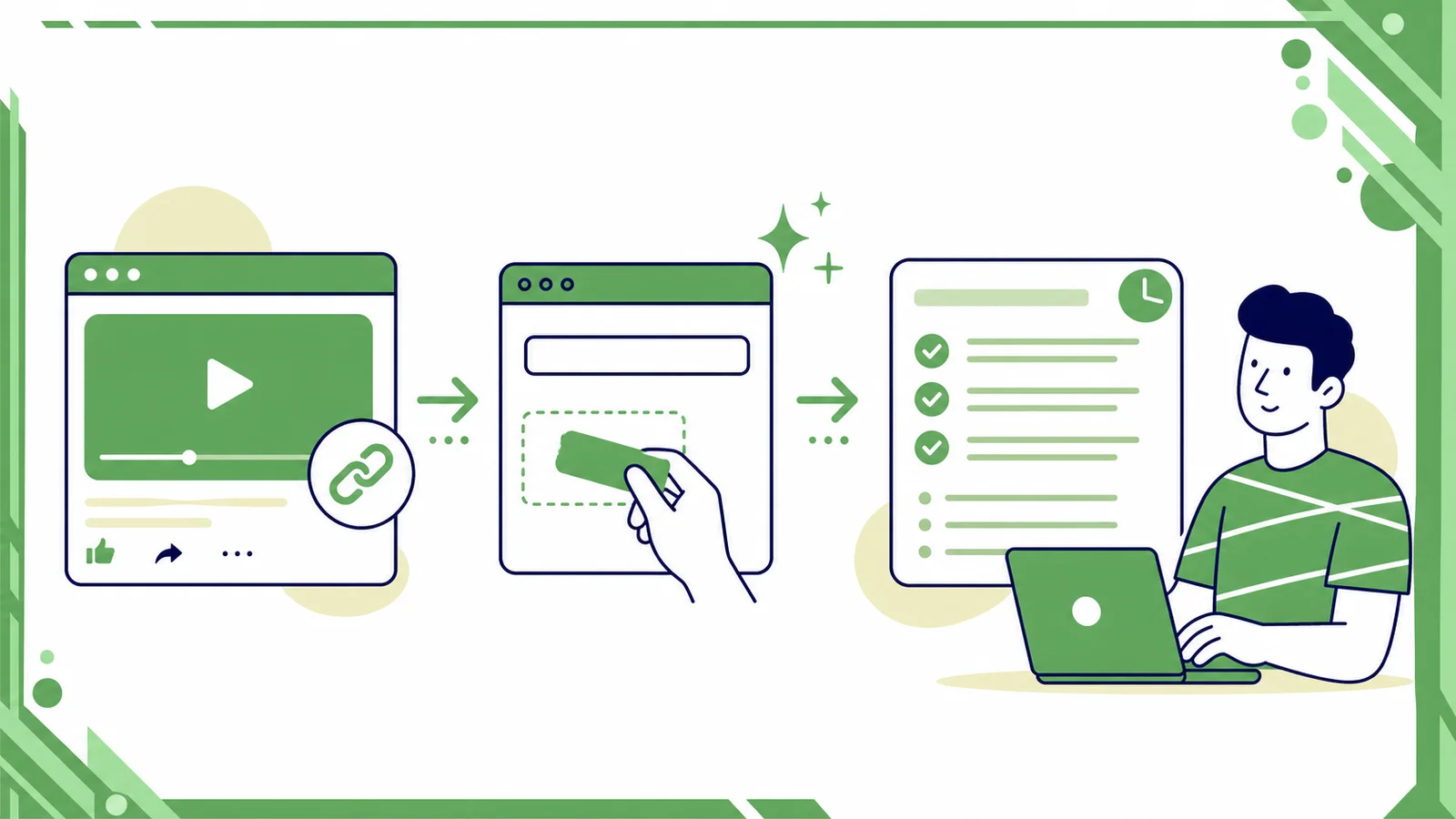
Most AI tools do not watch a YouTube video as a person would. For lectures, interviews, news, and other speech-led videos, the main input is the caption track or transcript. A summarization workflow obtains that text, cleans it, asks a language model to organize it, and then sends the reader back to the original video for important checks.
You can follow the same process with any long-context AI tool. The method has three parts: obtain a reliable transcript, explain the result you need, and verify the output.
How the process works
- Read the video title, channel information, and available caption languages.
- Choose a caption track and remove obvious repetition, noise, and recognition errors.
- Send the transcript and the requested summary structure to a language model.
- Generate an outline, connected explanation, or key takeaways.
- Check important facts, quotations, and visual information against the video.
1. Obtain and prepare the transcript
You can copy a transcript from YouTube when one is available or use a caption tool you trust. Human-edited captions are usually more accurate. Automatic captions may mishear names, technical terms, numbers, and speaker changes.
- Remove repeated lines, sound labels that add no meaning, and obvious corruption.
- Keep chapter and topic boundaries.
- Preserve speaker names in conversations whenever possible.
- Correct obvious errors in names, products, and figures before summarizing.
2. Give the AI a precise brief
A useful prompt states the purpose, audience, output structure, and factual constraints. “Summarize this” is rarely enough.
You are a content analyst. Use only the transcript I provide.

Purpose: help me decide whether to watch the full video and keep useful notes.
Audience: someone interested in the topic who has not watched the video.

Return:
1. The question the video addresses
2. Three to seven central ideas
3. The evidence or examples used for each idea
4. Items that should be checked in the original video
5. A short conclusion

Do not invent information. Mark uncertainty and preserve important names and numbers.
3. Verify and reshape the result
Treat an AI summary as a reading aid, not a verified source. Check names, dates, numbers, quotations, and specialist terms. Make sure the ending and opposing views were not lost, distinguish the speaker's claims from established facts, and inspect any visual demonstration that captions cannot express.
What does our YouTube summarizer automate?
Paste a video link and the service retrieves available captions, prepares the text, generates one of three summary structures, and saves the result. It is useful when you regularly process videos, switch output languages, or want consistent notes without repeating the same setup work.
Know the limits
- A video without usable captions cannot enter this text-based workflow.
- Captions do not capture charts, movement, music, or all aspects of tone.
- Automatic captions and language models can both make mistakes.
- High-stakes information must be checked against primary and professional sources.
Conclusion
The essential method is simple: obtain the best transcript available, tell the AI exactly what to preserve, and verify the result against the original. A dedicated YouTube summarizer saves time by automating those repeated steps.